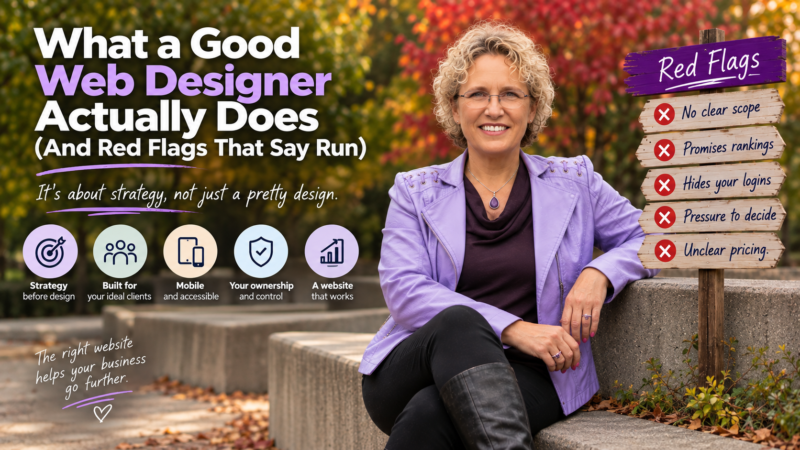
A good web designer doesn’t begin by asking which color you like. They begin by learning how your business works. They ask who needs your help, what those people search for, and what should happen next.
What a good web designer does reaches far beyond making pages look attractive. The real work includes strategy, structure, trust, accessibility, mobile usability, ownership, and testing. So let’s pull back the curtain.
Key Takeaways
- A good web designer starts with business goals and client needs.
- Design should guide decisions, not merely decorate pages.
- You should own your domain, website, content, and logins.
- Clear scope, pricing, and communication protect the project.
- Search and mobile planning should begin before launch.
- Pressure, secrecy, and platform lock-in are serious red flags.

Written by Dotty Scott
Founder of Premium Websites, Inc.
Empowering small businesses to go from Invisible to Invincible.
Table of Contents
- What Does a Good Web Designer Do?
- What Happens Before Design Starts?
- What Happens During the Build?
- What Happens After Launch?
- How Do Professional and Problematic Designers Compare?
- Which Red Flags Say Run?
- Who Should Own the Website?
- What Should You Ask Before Hiring?
- The Bottom Line
- Frequently Asked Questions
What Does a Good Web Designer Actually Do?
A good web designer turns business goals into a clear online experience. They connect design choices with real visitor decisions. Every page should answer a question, build trust, or invite action.
That requires more than technical skill. It requires listening, planning, explaining tradeoffs, and protecting the client’s interests. A beautiful website can still fail completely.
If it confuses visitors or stays invisible, it isn’t doing its job.
What Should Happen Before Design Starts?
Professional website work begins with discovery and planning.
Your designer should understand:
- Your services and most profitable work
- Your ideal client and their real questions
- Your geographic service area
- Your competitors and market position
- Your required forms and integrations
- Your primary call to action
- Your future growth plans
They should also discuss content, photography, domain access, hosting, timelines, and responsibilities.
Skipping discovery usually creates expensive changes later.
What Should a Good Web Designer Do During the Build?
A good web designer builds structure before polishing details. They create clear navigation and logical page relationships. They write or organize headings that explain each page.
They test layouts on phones, tablets, and desktop screens. They compress images and protect basic performance. They add trust signals where visitors need reassurance.
They also keep you informed. You should understand what is finished, what needs approval, and what comes next. Confusion shouldn’t be part of the service.
What Should Happen After the Website Launches?
Launch is a checkpoint, not the end of professional responsibility. Your designer should test forms, links, redirects, mobile layouts, analytics, and search access. They should provide your logins and explain routine maintenance.
You should know who handles backups, updates, security, and future edits. Google notes that search changes may take hours or several months. No ethical designer can promise an exact ranking date.
A managed WordPress hosting plan can keep the technical foundation maintained afterward.
Professional Web Designer Versus Website Order Taker
| Area | Professional Designer | Website Order Taker |
|---|---|---|
| Starting point | Business goals | Colors and templates |
| Questions | Specific and strategic | Minimal |
| Ownership | Clearly assigned to you | Often unclear |
| Communication | Regular and understandable | Reactive or inconsistent |
| Launch | Tested and documented | Handed over quickly |
Which Web Designer Red Flags Say Run?
The strongest red flags involve ownership, secrecy, pressure, and unrealistic promises.
- They register your domain in their own name.
- They refuse to provide administrator access.
- They promise guaranteed first-place Google rankings.
- They can’t explain recurring fees.
- They have no written scope or revision process.
- They use fear to force a quick decision.
- They disappear for long stretches without updates.
- They won’t explain what platform they use.
- They show work but can’t identify their role.
Full transparency: one red flag deserves a conversation.
Several red flags deserve an exit.
Who Should Own Your Website and Domain?
You should own the business assets you paid to create. That includes your domain, written content, images, analytics accounts, and platform logins. Your designer may manage those assets with permission.
Management isn’t ownership. I give clients full access because businesses shouldn’t be held hostage.
My custom WordPress website process includes client ownership and training.
Did you know… Losing access to your domain can interrupt your website and business email together.
What Should You Ask Before Hiring a Web Designer?
Ask direct questions and expect understandable answers. Use these website designer questions to ask before hiring as a practical checklist.
- Who will own the domain and website?
- Which platform will you use?
- What is included in the quoted price?
- Who provides the written content?
- How many revisions are included?
- How will mobile layouts be tested?
- What search setup is included?
- What happens after launch?
- Can I move the website elsewhere?
- Will I receive every login?
Use my website design checklist before your first planning call.
The Bottom Line
A good web designer gives you clarity, ownership, and a website with purpose. They won’t hide behind technical language. They will explain choices and tell you when an idea won’t help.
Look for someone who asks thoughtful questions before offering solutions. Twenty years and serving over 629 website customers taught me one thing. The best projects begin with trust on both sides.
Read my client reviews to see what supported website work feels like. I’ve got your back.
Frequently Asked Questions
How do I know whether a web designer is legitimate?
Check real work, reviews, business history, contact information, and contract terms.
Ask who owns the domain and platform account.
Should a web designer understand SEO?
They should understand search-friendly structure, mobile usability, headings, speed, and crawlability.
Advanced SEO may remain a separate service.
How much should a professional website cost?
Cost depends on pages, content, integrations, custom functions, and support.
Request a detailed scope instead of comparing one total number.
Should my designer provide administrator access?
Yes. Business owners should retain access to their own digital assets.
Can a web designer guarantee Google rankings?
No ethical professional can guarantee a specific organic position. Search results depend on many factors outside one person’s control.
Read the rest of the posts in this series: The Honest Truth about Your Website
- Is Your Website Actually Working? (Or Just Sitting There Looking Pretty)
- Why the Phone Isn’t Ringing (And It’s Probably Not What You Think)
- The Truth About AI-Built Websites (What They Don’t Tell You Before You Click Generate)
- The Truth About Wix, Squarespace, and DIY Website Builders
- What a Good Web Designer Actually Does (And Red Flags That Say Run)
- Why Your Competitor Shows Up on Google and You Don’t
- What Is Schema Markup (And Why You Should Care)
- Does Your Business Show Up in ChatGPT? Here’s How to Find Out