SEO feels overwhelming for most small business owners. There are hundreds of ranking factors. Endless tools. Conflicting advice from every corner of the internet.
But a solid small business SEO plan doesn’t have to be complicated. You don’t need to do everything. You need to do the right things in the right order.
And in 2026, there’s a new layer to consider. Getting SEO for small businesses right in 2026 means going beyond Google. AI answer engines like ChatGPT, Perplexity, and Gemini now answer questions directly. They cite their sources too. Getting cited by those tools is called AEO (Answer Engine Optimization). AEO for small businesses uses the same foundation as SEO. This plan builds both at once.
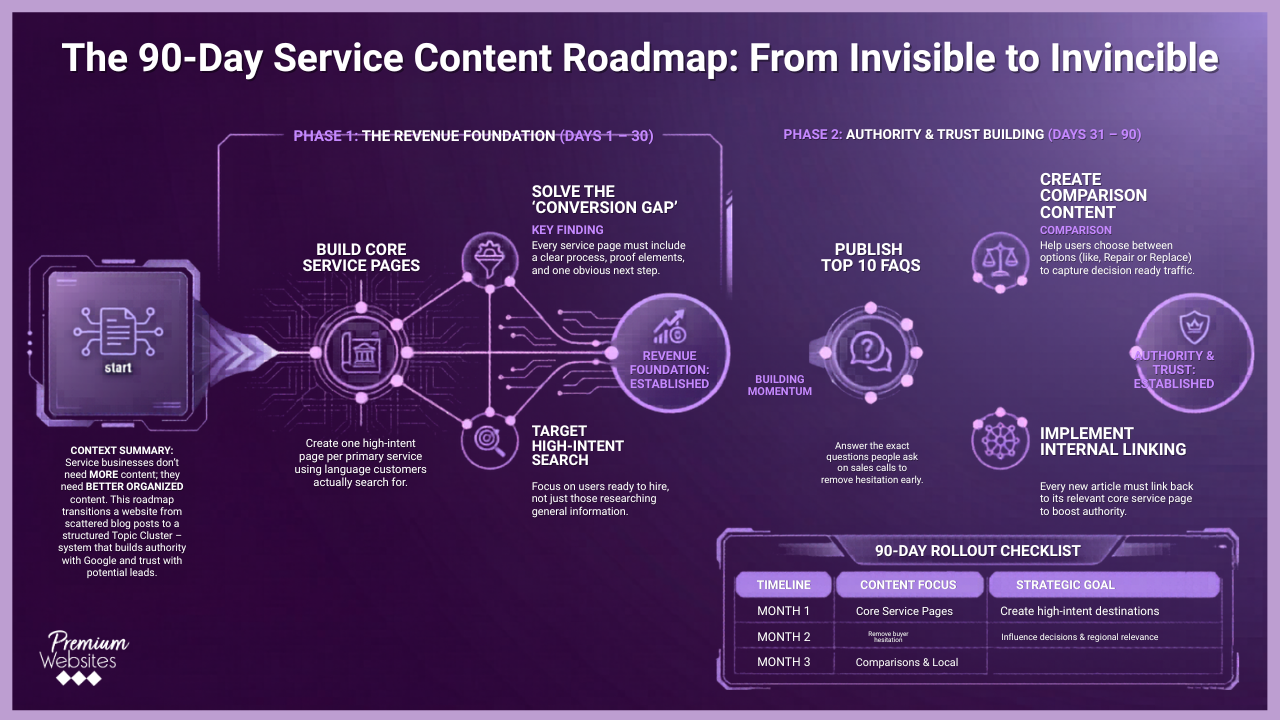
This 90-day plan is divided into three focused months. Each one builds on the last. By month three, you’ll have the foundation that Google and AI engines need to recommend your business.
Let’s get into it.

Written by Dotty Scott
Founder of Premium Websites, Inc.
Empowering small businesses to go from Invisible to Invincible.
Table of Contents
- Why Your Small Business SEO Plan Needs 90 Days
- Key Takeaways
- Month 1: Build Your Technical Foundation
- Month 2: Create Strategic Content
- Month 3: Build Authority and Trust
- Your Full 90-Day SEO/AEO Roadmap at a Glance
- What to Expect: A Realistic Timeline
- Common Small Business SEO Plan Mistakes to Avoid
- Summary
- FAQ
Why Your Small Business SEO Plan Needs 90 Days
90 days is the minimum timeframe for Google and AI engines to reward your efforts.
SEO is not instant. Google needs time to crawl your changes. It re-evaluates your site and compares you against competing pages. AI engines like Perplexity and ChatGPT update their citations on their own schedule. Most businesses expect results in two weeks. They quit at day 45, right before momentum starts building.
Ahrefs research shows something striking. Fewer than 6% of new pages rank in the top 10 within a year. Pages that do rank share three traits: strong technical foundations, relevant content, and credible backlinks. All three take time to build.
90 days gives you enough time to do the work correctly. You’ll begin to see early signs of progress in both traditional search and AI-generated answers.
Did you know: SEO was invented in the mid-1990s. That’s less than a decade after the first website went live. The term “search engine optimization” dates back to a 1997 spam email promoting a book titled “Maximize Your Website Visibility.” Today, the global SEO industry is worth more than $80 billion annually. AEO didn’t even have a widely used name until AI chatbots went mainstream in 2023. Businesses that take both seriously are building assets. Those assets generate leads long after the active work stops.
Key Takeaways
- A small business SEO plan works best when steps are done in the right order.
- Month 1 fixes what’s broken: speed, security, mobile usability, and site structure.
- Month 2 creates content that matches what your ideal clients are actively searching for.
- Month 3 builds trust through backlinks, reviews, E-E-A-T signals, and lead conversion.
- AEO for small businesses uses the same foundation as SEO. Structured content and direct answers serve both.
- A consistent 90-day SEO plan produces measurable improvements in rankings and traffic.
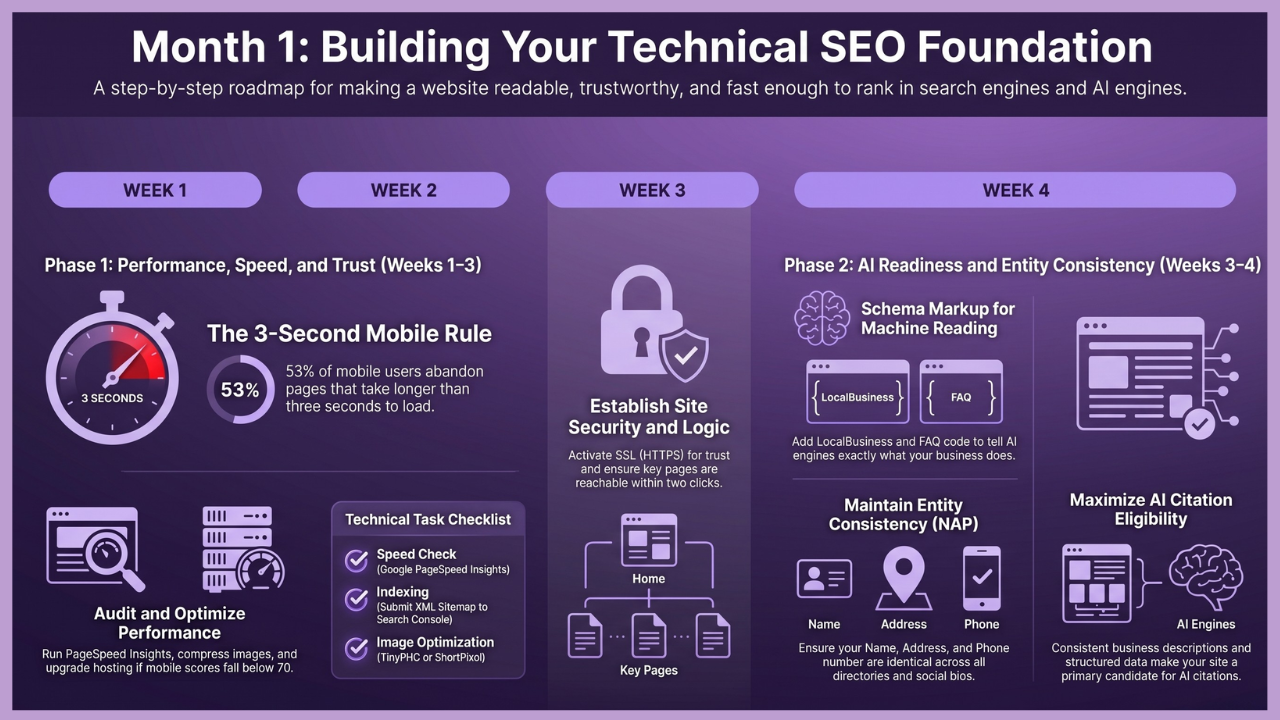
Month 1: Build Your Technical Foundation
Month 1 is about making your site readable and trustworthy to search engines.
You can’t rank a site that loads slowly, breaks on mobile, or confuses crawlers. Technical issues are invisible to most business owners. They’re very visible to Google.
This month, your focus is on your site’s infrastructure. Think of it as clearing the road before you drive.
Week 1-2: Speed and Mobile Performance
Your website must load in under 3 seconds on mobile. 53% of mobile users abandon pages that take longer to load. Google now uses mobile performance as a primary ranking signal.
Actions to take:
- Run your site through Google’s PageSpeed Insights
- Compress all images using a tool like TinyPNG or ShortPixel
- Remove unused plugins or apps slowing your load time
- Upgrade your hosting if your mobile score is below 70
Week 2-3: Security and Site Structure
An HTTP site sends a trust warning to both visitors and Google. If you haven’t switched to HTTPS, this is week two’s priority.
Actions to take:
- Confirm your SSL certificate is active (your URL should show https://)
- An SSL Certificate should come free in quality hosting accounts for non-ecommerce websites.
- Fix broken links using a free tool like Broken Link Checker
- Simplify your navigation so every key page is reachable within two clicks
- Submit your XML sitemap to Google Search Console
Week 3-4: Schema Markup, Entity Consistency, and AEO Signals
This is where SEO and AEO intersect most directly. Schema markup is code that tells Google exactly what your business does. Entity consistency means your name, address, phone number, and description match everywhere you appear online.
AI engines pull information from structured data and consistent entity signals. When they can identify what your business does, you become a candidate for citation. This is the core of AEO for small businesses. It makes your site easy for machines to read and trust.
Actions to take:
- Add LocalBusiness schema markup to your homepage
- Add the FAQ schema to any page with a question-and-answer section
- Write a clear, consistent business description and use it word-for-word across your website, Google Business Profile, social media bios, and directory listings
- Check that your Name, Address, and Phone number (NAP) are identical across every directory
At Premium Websites, Inc., we see this constantly. NAP inconsistencies and vague business descriptions are widely overlooked. Both suppress local rankings. Both reduce AI citation eligibility.
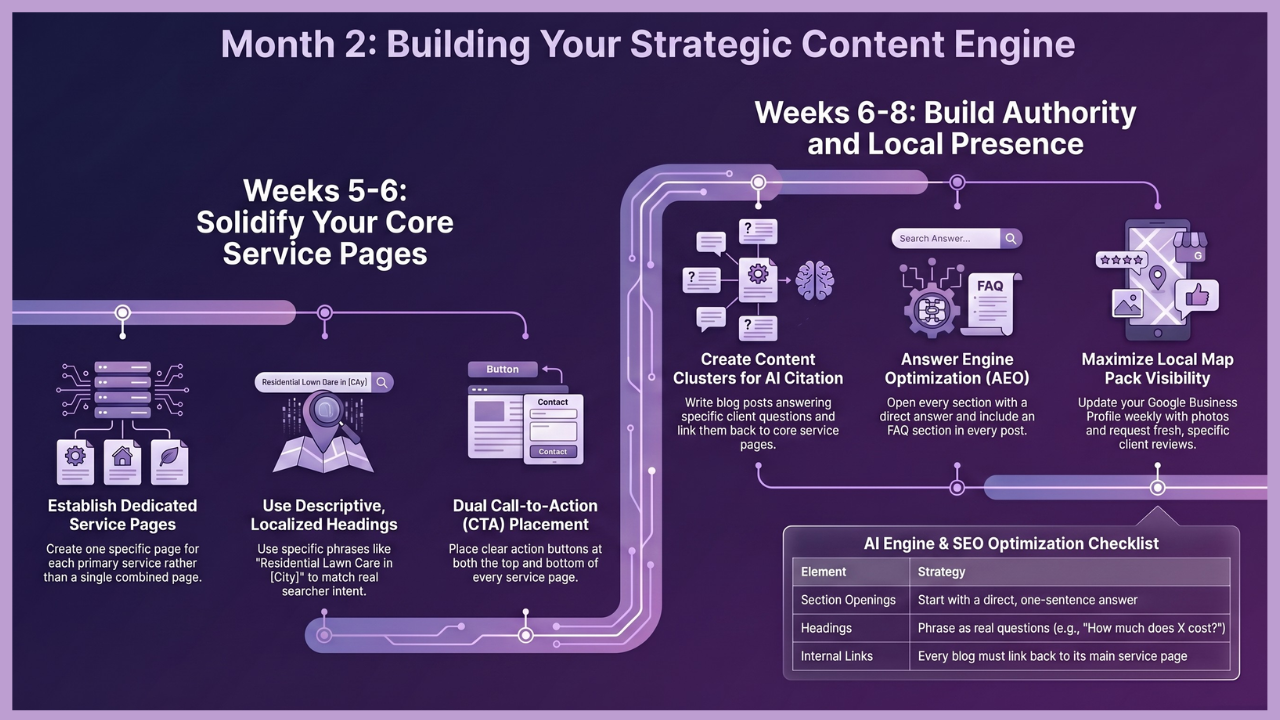
Month 2: Create Strategic Content
Month 2 is about creating content that matches what your ideal clients are searching for.
This is the content phase of your small business SEO plan. In 2026, Google rewards content that directly serves a searcher’s intent. AI engines reward content that gives direct, structured answers. Both goals are achieved through clear writing, logical structure, and genuine expertise.
Week 5-6: Audit and Strengthen Your Service Pages
Your service pages are your most important ranking assets. Each one should target a single specific keyword. It should answer the searcher’s question completely.
Actions to take:
- Identify your top three to five services
- Give each service its own dedicated page, not one combined “Services” page
- Write descriptive, specific headings (“Residential Lawn Care in [City]” beats “Our Services”)
- Add a clear call to action at the top and bottom of every service page
Week 6-7: Build a Content Cluster and Write for AI Citation
A content cluster links multiple blog posts to a single core service page. It signals topical authority to Google. Structure matters as much as the topic for AEO for small businesses.
AI engines extract answers. They don’t read linearly. Every section of your blog posts should open with a direct answer before expanding. Use headings that mirror real questions. Add an FAQ section to every post.
Actions to take:
- Pick your most important service
- Write two to three blog posts answering questions your clients ask before hiring someone like you
- Open every section with a direct answer before elaborating
- Link each blog post back to the main service page
- Use headings phrased as real questions (“How much does X cost?” “What’s the difference between X and Y?”)
Week 7-8: Optimize for Local Search
If you serve a specific area, local SEO is one of your fastest wins. Google’s local results, the map pack, appear above organic results on most service searches.
Actions to take:
- Claim and fully complete your Google Business Profile
- Add photos, hours, services, and a description that includes your target keywords
- Post to your Google Business Profile at least once a week
- Ask satisfied clients for a Google review. Fresh, specific reviews are one of the highest-impact local ranking signals available.
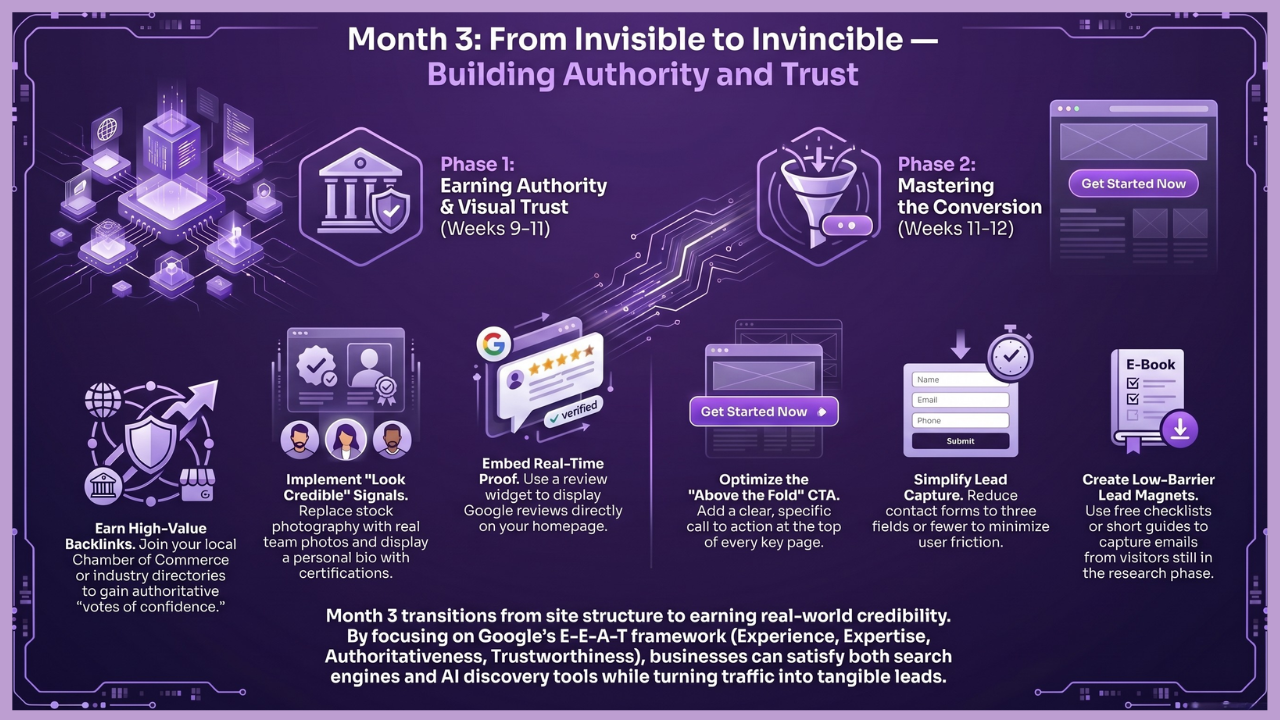
Month 3: Build Authority and Trust
Month 3 is about proving your business is credible, established, and worth recommending.
Google’s E-E-A-T framework (Experience, Expertise, Authoritativeness, Trustworthiness) influences how well your site ranks. It also determines whether AI engines cite you. Perplexity, ChatGPT, and Gemini favor sources with real expertise and real-world credibility. Authority isn’t claimed. It’s earned.
Week 9-10: Earn Your First Backlinks
A backlink is a link from another website to yours. Google treats them as votes of confidence. Not all backlinks carry equal weight. A Chamber of Commerce link carries far more value than a random directory listing.
Actions to take:
- Join your local Chamber of Commerce and request a listing with a link to your site
- Reach out to complementary businesses about a mutual mention or guest post
- Submit your business to reputable industry directories
- Look for local news sites or podcasts that feature small business owners
Week 10-11: Add Trust Signals to Your Website
At this point in your 90-day SEO plan, your site is fast and well-structured. Now it needs to look credible at a glance.
At Premium Websites, Inc., we see trust signals make a measurable difference in conversion rates. Visitors who see reviews and real photos are far more likely to reach out.
Actions to take:
- Add your Google reviews to your homepage using a review widget
- Replace stock photos with real headshots and team photos
- Display certifications, awards, memberships, or press mentions
- Add a short personal bio to your About page with a real photo and your story
Week 11-12: Fix Your Conversion Rate
SEO and AEO bring people to your door. Your website has to get them to knock. This final step connects everything you’ve built.
Actions to take:
- Add a clear, specific call to action above the fold on every key page
- Simplify your contact form to three fields or fewer
- Create a simple lead magnet, like a free checklist or short guide, to capture emails from visitors not yet ready to hire
- Set up a basic email follow-up sequence to stay in touch with new leads
Your Full 90-Day SEO/AEO Roadmap at a Glance
| Week | Focus Area | Key Actions |
|---|---|---|
| 1-2 | Speed and Mobile | PageSpeed audit, image compression, and hosting review |
| 2-3 | Security and Structure | HTTPS, broken links, navigation, sitemap submission |
| 3-4 | Schema, Entity, AEO | Schema markup, NAP consistency, business description |
| 5-6 | Service Pages | Dedicated pages, keyword targeting, CTAs |
| 6-7 | Content and AEO | Blog posts, direct answers, internal linking |
| 7-8 | Local SEO | Google Business Profile, reviews, and local keywords |
| 9-10 | Backlinks | Chamber of Commerce, guest posts, directories |
| 10-11 | Trust Signals | Reviews widget, real photos, credentials |
| 11-12 | Conversion | CTA audit, simplified form, lead magnet |
What to Expect: A Realistic Timeline
SEO and AEO results build gradually. Here is what to expect, month by month.
Most small business owners want to know when they’ll see results. The honest answer depends on your competition and how consistently you do the work.
That said, here is the general pattern most businesses follow:
- Month 1: Technical improvements get indexed. Google starts re-crawling your site. Core Web Vitals scores begin improving. Schema markup goes live and becomes readable by AI engines.
- Month 2: Updated pages start ranking for lower-competition keywords. Local search visibility often improves first. Some content may begin appearing in AI-generated answers.
- Month 3: Backlinks and trust signals begin compounding. Traffic increases become more consistent. AI citation eligibility grows as authority signals strengthen.
- Month 4 and beyond: Rankings stabilize and grow. Content clusters build topical authority. AI engines are increasingly citing your site as a credible source.
SEO and AEO are long games. Businesses that win treat them like systems, not one-time projects.
Common Small Business SEO Plan Mistakes to Avoid
These mistakes account for most failed SEO and AEO efforts among small businesses.
- Skipping the technical phase. Content and backlinks won’t help a slow or broken site. Start with the foundation every time.
- Writing content without keyword research. Publishing posts on topics nobody searches for wastes time. It produces no rankings or citations.
- Ignoring direct answer structure. AI engines extract short, clear answers. If your content buries its point, it won’t get cited.
- Chasing quantity over quality in backlinks. Ten links from spammy directories can hurt your rankings. One link from a legitimate local organization helps.
- Ignoring Google Business Profile. Local businesses that neglect their GBP miss the fastest SEO win available to them.
- Stopping after month one. Month one sets the foundation. Months two and three are when results begin to show up.
- Not tracking results. Set up Google Search Console and Google Analytics before you start. Without data, you cannot measure progress or make smart decisions.
Remember
A small business SEO plan works best when it’s sequential. Month 1 removes the technical barriers that prevent Google from trusting your site. Month 2 creates the content that attracts the right visitors. Month 3 builds the authority that turns rankings and citations into real business.
Each month builds on the last. Skipping ahead rarely works. Consistent, sequential work is what separates businesses that see results from those that don’t.
This post ties the whole series together. Technical SEO, backlinks, E-E-A-T, trust signals, and conversion all fit into one connected system. This roadmap is how you put it into practice.
Need help choosing your next step? Compare my one-time SEO services. WebHub focuses on your connected digital footprint, and PremiumSchema adds structured data to your website. They’re separate services, so we’ll discuss what fits before you purchase.
FAQ
What should a small business SEO plan include?
A solid small business SEO plan covers three areas: technical foundation, strategic content, and authority building. The technical phase addresses speed, mobile performance, security, and schema markup. The content phase creates service pages and blog posts built around real search queries. The authority phase builds backlinks, trust signals, and a conversion system. Skipping any phase typically means the other two underperform.
How long does a 90-day SEO plan take to show results?
Most small businesses begin seeing measurable improvements between 60 and 90 days after starting. Early wins often appear first in local search. The Google map pack tends to respond faster than organic rankings. AI citations can appear sooner if your content is well-structured and schema markup is live. Results compound over time. The effort from month one keeps paying off six months later.
What is AEO for small businesses, and how is it different from SEO?
SEO focuses on ranking in Google’s traditional search results. AEO focuses on being cited by AI tools such as ChatGPT, Perplexity, and Gemini. The two overlap significantly. Strong technical foundations, clear content structure, schema markup, and E-E-A-T signals serve both. The main AEO-specific addition is the use of a direct question-and-answer format. This makes it easy for AI engines to extract and cite your content.
How to improve website rankings for small business
Here is how to improve website rankings. Small business owners should start with three priorities: technical foundation, targeted content, and credible backlinks. Fix your speed, mobile performance, HTTPS, and schema markup first. Then create content around the keywords your clients use when ready to hire. Then build backlinks from local and industry sources. Google Business Profile optimization is often the fastest way to achieve a ranking win. Working your plan steadily for 90 days produces far better results than a single big push followed by a stop.
Can I do SEO myself, or should I hire someone?
Many small business owners handle the basics themselves. Claiming your Google Business Profile, publishing blog content, compressing images, and gathering reviews are all very doable. Where things get more technical, such as schema markup, site speed fixes, and backlink outreach, professional help saves time and prevents costly mistakes. A hybrid approach tends to work best. Handle the content yourself and bring in support for the technical pieces.
What’s the difference between SEO and local SEO?
Standard SEO focuses on ranking in general search results for keywords related to your service. Local SEO focuses on ranking in location-based results. That includes the Google map pack and searches that include a city or neighborhood. For most service businesses, local SEO is the higher priority because buyers search locally. The 90-day plan covers both, with local SEO getting dedicated attention in month two.
Read the rest of the posts in this series
- Small Business SEO Playbook (2026 Edition)
- Technical SEO for Service Businesses (2026 Edition)
- Google Business Profile Optimization for Service Businesses (2026 Edition)
- Content Strategy for Service Businesses (2026 Edition)
- On-Page SEO for Service Businesses (2026 Edition)
- AI Search Optimization for Small Businesses (2026 Edition)
- Authority and Trust Signals for Small Business SEO (2026 Edition)
- Why Your Website Gets Traffic but No Leads (2026 Edition)
- The 90-Day Small Business SEO Plan: 2026 AEO Edition
- Keyword Research for Service Businesses (2026 Edition)
- Measuring SEO Results for Service Businesses (2026 Edition)