Originally published November 21, 2008. Updated October 10, 2026.
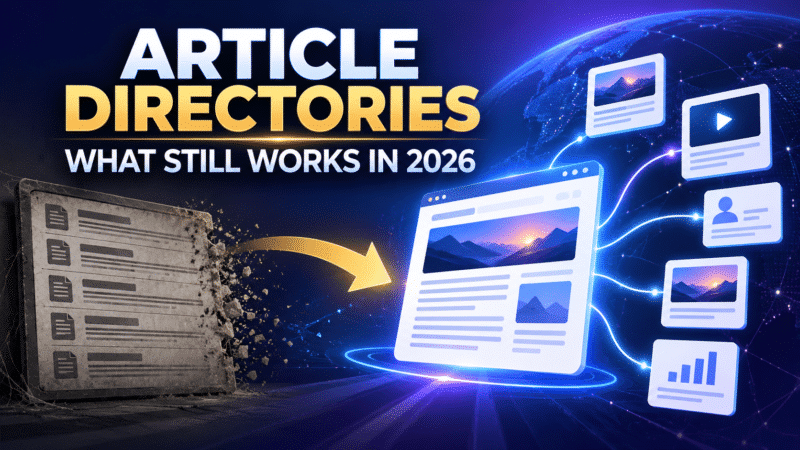
Article directories used to be a standard SEO recommendation. You wrote an article, submitted it to as many directories as possible, and added a link back to your website. That strategy is outdated.
So, are article directories still useful? Not as a backlink shortcut. The better goal in 2026 is to publish helpful content where your ideal clients will actually see it, while keeping your own website as the original home of your best material.
Key Takeaways
- Old-style article directory submissions are no longer a dependable SEO tactic.
- Your own website should be the original home of your strongest content.
- LinkedIn, Medium, Substack, industry publications, and Google Business Profile can extend your reach when used intentionally.
- Publish to help people and build visibility, not to manufacture backlinks.
- A focused distribution system is more useful than submitting the same article everywhere.

Written by Dotty Scott
Founder of Premium Websites, Inc.
Empowering small businesses to go from Invisible to Invincible.
Table of Contents
- Are Article Directories Still Good for SEO?
- What Happened to the Old Article Directories?
- Best Places to Publish Articles in 2026
- Where Should You Publish?
- What About Quora and Similar Platforms?
- Article Submission Sites to Avoid
- A Better Content Distribution Plan
- Build Authority From a Website You Own
- Frequently Asked Questions
Are Article Directories Still Good for SEO?
Traditional article directories are not a reliable way to improve rankings. Google identifies links created primarily to manipulate search rankings as link spam. Google has also warned specifically about large-scale article campaigns whose main purpose is building links.
That does not mean publishing away from your own website is always a bad idea. A thoughtful article on a respected industry website can introduce you to new readers, demonstrate your expertise, and generate referral traffic. The difference is intent. Publish to help people and build visibility, not to manufacture links.
What Happened to the Old Article Directories?
Many of the directories that were popular years ago either disappeared, lost their readership, or became crowded with low-quality content. Others still exist, but simply being listed there does not make your business more credible.
Full transparency: submitting the same generic article to dozens of websites is usually a poor use of your time. It can create duplicate versions of your content without bringing you qualified visitors. Your strongest article should live on a digital property you control.
Best Places to Publish Articles in 2026
1. Your Own Website
Your website should be the first home for your original articles. You control the content, calls to action, internal links, analytics, and long-term access. A useful post can support your search visibility for years, especially when it is updated as information changes.
Start with a clear content strategy for your service business. Each article should answer a real question, connect to the service it supports, and guide the reader to a sensible next step.
2. LinkedIn Articles and Newsletters
LinkedIn is useful when your ideal clients and referral partners are active there. Articles give you room to teach a topic in depth. According to LinkedIn’s newsletter guidance, newsletters let people subscribe and receive notifications when you publish a new edition.
Instead of copying your entire website article word for word, consider adapting it for LinkedIn. Share the strongest lesson, add a story or opinion, and link to a related resource on your website when that link genuinely helps the reader.
3. Medium
Medium can expose your writing to readers beyond your existing network. It is also one of the safer places to republish an article because Medium provides an import tool and a canonical-link setting. A canonical link tells search engines that the version on your website is the original source.
Publish on your website first. Then use Medium’s official import tool or manually set the canonical URL before promoting the Medium version.
More Useful Publishing Options
4. Substack
Substack combines web publishing with email delivery. It makes sense when you want to build a subscriber relationship and publish consistently. Your posts can appear on the web, go to subscribers by email, or both.
Think of Substack as an email and community platform, not a link-building directory. If you already have an email marketing system that works well, you may not need another platform.
5. Industry Publications and Professional Associations
A respected trade publication, local business organization, or professional association can be more valuable than dozens of general directories. These websites already serve a specific group of people. That gives your article context and gives readers a reason to trust the publication.
Choose opportunities where you can contribute something genuinely useful. Avoid arrangements that require keyword-heavy links or exist only to sell placement.
6. Google Business Profile Posts
Google Business Profile posts are not full article directories, but they are useful for local visibility. You can share an update, offer, event, photo, video, and a button that sends people to a relevant page on your website.
Use these posts to point people toward a complete article, service page, or timely announcement. For a deeper plan, see my guide to Google Business Profile optimization.
Where Should You Publish?
| Platform | Best Use | Main Caution |
|---|---|---|
| Your website | Original, complete articles | Keep content current |
| Professional reach and newsletters | Adapt the article for the platform | |
| Medium | Republishing to new readers | Set the canonical URL |
| Substack | Email and subscriber relationships | Avoid adding a second system you will not maintain |
| Industry publications | Credibility with a relevant community | Choose quality over quantity |
| Google Business Profile | Local updates and timely promotion | Link to the complete resource on your site |
What About Quora, Tumblr, and Similar Platforms?
They can still have a place when you already participate in the community. Answering a real question on Quora or publishing for an established Tumblr following may build recognition. However, dropping links into posts solely for SEO is not a strategy I recommend.
Ask one question before using any outside platform: Are my ideal clients or credible referral partners actually here? If the answer is no, your time is probably better spent improving your own website and email list.
Article Submission Sites to Avoid
Be cautious with any site that promises easy rankings, accepts almost anything, encourages mass submission, or focuses more on backlinks than readers. I no longer recommend old-style directory submissions such as EzineArticles, ArticleBiz, ArticleCube, or similar general article banks as an SEO tactic.
Also avoid:
- Publishing the same article across many low-quality sites
- Paying for a post solely to receive a ranking link
- Using keyword-stuffed anchor text in contributed articles
- Automating submissions to hundreds of websites
- Posting thin content that does not help the reader
A Better Content Distribution Plan
- Publish the complete article on your website first.
- Give search engines time to discover the original. Make sure the post is included in your sitemap and linked from another relevant page.
- Create platform-specific versions. Turn the article into a LinkedIn post, newsletter edition, short video, email, or Google Business Profile update.
- Use canonical settings when you republish the full article. Medium makes this especially straightforward.
- Track what sends qualified visitors. Views are nice, but inquiries, email signups, and discovery calls matter more.
- Update the original article. A useful resource should improve over time rather than disappear into an archive.
This approach supports authority without depending on outdated directory links. It also gives you more value from every article you create.
Build Authority From a Website You Own
The goal is not to scatter articles across the Internet. The goal is to become the clear, trusted answer when someone needs what you do.
If writing and optimizing consistent content keeps falling to the bottom of your list, take a look at my blog post writing service. I can help you turn what you know into useful articles that support your visibility and your business.
If your business details are scattered across profiles and directories, WebHub’s one-time digital-footprint setup is another option to discuss. It’s separate from blog writing and doesn’t guarantee rankings.
I’ve got your back.
Frequently Asked Questions
Do article directories still help SEO?
Traditional article directories are not a dependable SEO tactic. Links created mainly to influence rankings may be ignored or treated as spam. Publishing useful content on your own website and earning relevant mentions is a stronger long-term approach.
Can I publish the same article on my website and Medium?
Yes. Publish it on your website first, then use Medium’s import tool or canonical setting so the Medium version identifies your website article as the original source.
Is guest posting still worth doing?
It can be, when the publication is reputable, relevant to your work, and read by people you want to reach. Guest posting should be about education, visibility, and relationships. It should not be a mass backlink campaign.
Where should a small business publish first?
Start on your own website. Then choose one or two distribution platforms based on where your ideal clients spend time. A focused system is easier to maintain and usually produces better results than trying to publish everywhere.
Read the rest of the posts in this series: The Honest Truth about Your Website
- Is Your Website Actually Working? (Or Just Sitting There Looking Pretty)
- Why the Phone Isn’t Ringing (And It’s Probably Not What You Think)
- The Truth About AI-Built Websites (What They Don’t Tell You Before You Click Generate)
- The Truth About Wix, Squarespace, and DIY Website Builders
- What a Good Web Designer Actually Does (And Red Flags That Say Run)
- Why Your Competitor Shows Up on Google and You Don’t
- What Is Schema Markup (And Why You Should Care)
- Does Your Business Show Up in ChatGPT? Here’s How to Find Out